Math Strategies      
  • Home
  • Vocabulary
    • Semantic Mapping
    • Pre-Teaching Vocabulary
    • Teach Words in a Meaningful Context
    • Vocabulary Rating Guide
    • Personal Dictionary
  • Comprehension
    • K-W-L Strategy Chart
    • Text Box/Bag Activity
    • Survey Strategy and Guide
    • Main Idea/Detail Graphic Organizer
    • Evidence Guide Graphic Organizer
    • Compare/Contrast Matrix Graphic Organizer
    • Inference Graphic Organizer
    • Written Summaries
    • Oral Summaries
    • Cornell Notes
    • SQ3R (Survey, Question, Read, Recite, Review)
    • Interactive Think Aloud
    • Comprehension Monitoring Strategy Guide
    • Reciprocal Teaching
    • PLAN (Predict, Locate, Add, Notes)

K-w-l Strategy Chart

A K-W-L chart is used first to activate prior knowledge, then to help scaffold learn and to organize all the information gathered (Tompkins, 2014).   

K-W-L Strategy Chart

The K-W-L chart a widely used chart that has a number of benefits for multiple subjects and can be used for many different grade levels. It starts off having students activate their prior knowledge, thinking about what they already know about the topic. They are having a purpose for reading the text and they are able to monitor their own comprehension.

There are three main columns in the chart:
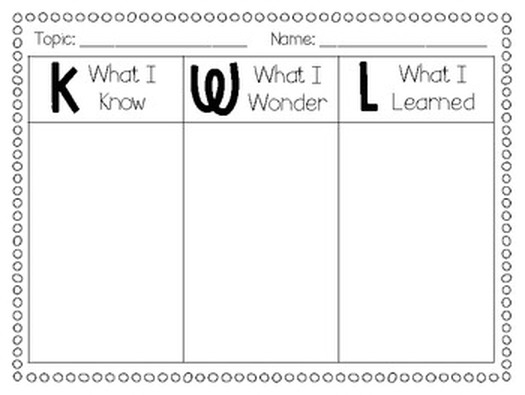
  • K - What We Know
  • W - What We Want to Learn (Wonder)
  • L - What We Learned
Students are writing what they know, thinking back to any prior information. Then, as a class they are completing what they want to learn or what they are wondering about. Finally, after instruction, they students list what they have learned (Miller & Veatch, 2011, p.57).
Picture
(Gardner, 2013)

Procedure

  1. Choose material that is appropriate and that discusses the topic that will be taught. It might be a textbook, but doesn't need to be, just something at their level.
  2. Create a K-W-L chart on the whiteboard, interactive board, chart paper, or overhead. It can be used anyway you wish.
  3. Next, hand out a computer paper with the chart already created, or a blank sheet of paper and have the students fold in into three columns. Students can then write the appropriate headings. Students should have their own charts to follow along and to be more engaged in the activity.
  4. Introduce the topic as well as walk through the text and model how to read the headings, captions, and boldfaced vocabulary.
  5. Students can record on their individual charts under the K column words that stood out to them, as words they know. Three to five is a good goal for students.
  6. After students have had some time on their own, ask them to come back to the class and share their knowledge and the teacher records under the K column on the class K-W-L chart.
  7. Ask students to record three to five questions that they might have about the topic on their individual K-W-L chart in the W column.
  8. Again, come back as a class and have individuals share some questions they may have and the teacher records it on the W column. The W column gives the students a purpose for reading, motivating students to continue to learn and be engaged in their learning.
  9. Students can then read the material.
  10. Students next use the L column on their individual charts to record five to seven concepts they learned while they read.
  11. Students will share again with the class on the concepts they learned and while sharing, the teacher will record the findings on the class K-W-L chart.
  12. Teacher models a think aloud. This is when they mention the prior knowledge (K), and compares the questions (W) with the concepts learned (L). The teacher can highlight or stress if some of the questions weren't answered, this way students will realize that they need monitor their own comprehension better.
  13. Questions that are unanswered may be answered by further research from students (Miller & Veatch, 2011, p.57-59).
Picture
(Little Green, 2013)
Kimberly Carey
Course: EEC 428
Professor: Dr. Lori Piowloski
Minnesota State University, Mankato

How to use a K-W-L Chart

(Literacy4DS, 2012)
This video does a great job of explaining how to use a K-W-L chart in your classroom. It shows how students are engaged in the learning process and how to complete the chart. Students will need a teacher to model how the use the chart for the first few times, eventually backing off and letting the students do the work. Students are able to monitor their own comprehension with the K-W-L chart and are able to see what they are learning. It will also be a great resource for later.

using a k-w-l chart to solve a word problem

(Gamble, 2011)
What I like most about this video is that it shows how to use it in math. It is just as important in math as it is in reading to really comprehend what you are reading and we need to show students strategies to use to help them comprehend on their own. By looking at the K-W-L chart, it is easy to visually see the students understanding and the background knowledge they are building on.

Tied into writing

Through this strategy, students are expected to engage individually, but also as teacher-led and as the teacher backs off, they can change some expectations and allow for group collaboration. The students are analyzing a topic that is their grade level and are required to really get involved in the instruction process and start thinking for themselves. Students can share ideas and help others come to conclusions about their concepts and again about their own.

CCSS.ELA-Literacy.W.6-8.2.a
Introduce a topic; organize ideas, concepts, and information, using strategies such as definition, classification, comparison/contrast, and cause/effect; include formatting (e.g., headings), graphics (e.g., charts, tables), and multimedia when useful to aiding comprehension (Common Core State Standards Initiative, 2015).


Picture
(Collaborative Research Project, 2010)

References

Collaborative Research Project. (2010, April 22). KWL [Table Photographed]. Retrieved from http://collaborative-research-project.wikispaces.com/KWL

Common Core State Standards Initiative. (2015). English Language Arts Standards. Retrieved from http://www.corestandards.org/ELA-Literacy/W/6/

Gamble, L. M. (2011, November 1). Using a kwl chart to solve a word problem [Video]. Retrieved from https://www.youtube.com/watch?v=X7u3Jy5KyT8

Gardner, B. (2013, August). KWL chart [Table]. Retrieved from https://www.teacherspayteachers.com/Product/KWL-Chart-595724

Literacy4DS. (2012, November 2). The kwl chart [Video]. Retrieved from https://www.youtube.com/watch?v=Qv-eOtO9f-A

Little Green. (2013, August 9). Little green. Retrieved from http://littlegreenteacher.blogspot.com/2013/08/freebie-friday-kwl-chart-graphic.html

Miller, M., & Veatch, N. (2011). Literacy in context (linc): choosing instructional strategies to teach reading in content areas for students grades 5-12. Boston: Pearson.

Tompkins, G. E. (2014, April 30). Education. Retrieved from http://www.education.com/reference/article/K-W-L-charts-classroom/

Powered by Create your own unique website with customizable templates.